
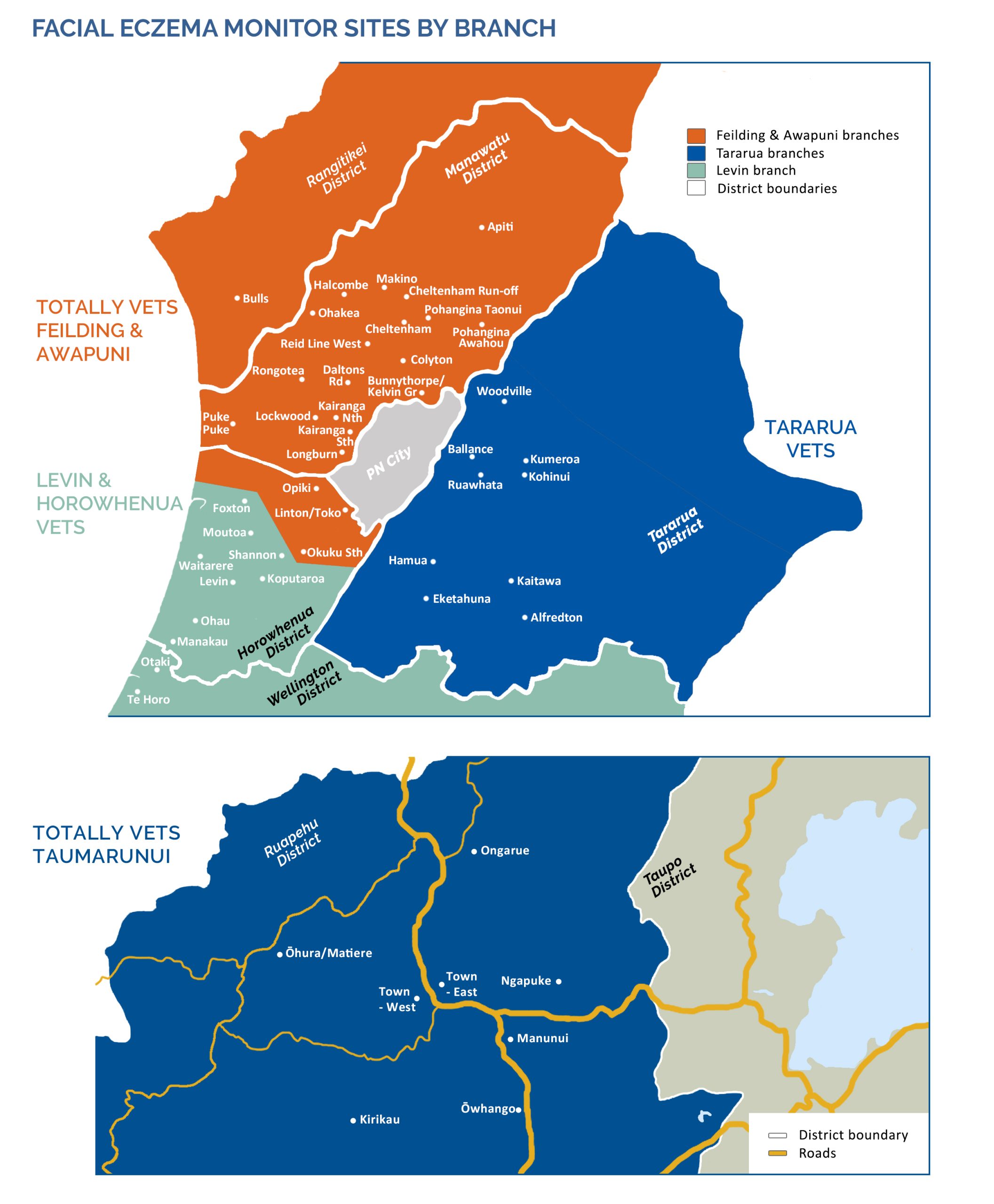
| Feilding | Awapuni | Tararua | Taumarunui | Levin | |
| No. of sites monitored: | 14 | 4 | 7 | 6 | 10 |
| Average Spore Count | 20,000 | 15,000 | 25,000 | 55,000 | 50,000 |
| Highest Spore Count: | 70,000 | 40,000 | 110,000 | 210,000 | 100,000 |
| Lowest Spore Count: | 0 | 0 | 0 | 0 | 10,000 |
| Facial Eczema Risk Rating (Based on average spore count) | MED-HIGH | LOW | MED-HIGH | HIGH | HIGH |
Please Note: a ‘0’ count indicates that there were no spores found in the sample. If a sample isn’t taken that week, this is indicated by a dash or ‘no sample’.
What is a toxic spore level? It is best not to use absolute levels, as stock grazing pasture with spore counts as low as 20,000-40,000 can sustain liver damage. More important considerations are rate of spore count rise, prevailing weather conditions, and grazing intensity at the time. Toxin effects on the liver are cumulative. Play it safe – start prevention as soon as spores are detected.
There have been increases at the drier sites too. Recent warm weather will be driving spore counts upwards. All stock should be receiving some form of zinc supplementation, and some may be coming up due for their second bolus.
If you have used zinc boluses in your stock, it would pay to double-check the calendar and see when they had their first bolus, so that they don’t end up with a lapse in protection with zinc.
If you have any questions, pop into the clinic or give us a call on 06 368 2891 (Extension 1 for the farm team)
Spore counting is $37 (incl GST) per sample, dropping to $30 for multiple samples. For instructions on how to cut grass see HERE
Click here for further advice on facial eczema prevention.
If you have any questions pop into the clinic or give us a call on 06 368 2891 (Extension 1 for the farm team)