Facial Eczema Risk Bulletin

Welcome to our Facial Eczema Spore Count Bulletin for 2026 – this article will be updated each week, so please revisit to see what the spore count is in your area.

10Facial Eczema Spore counts for week ending 17 April  2026
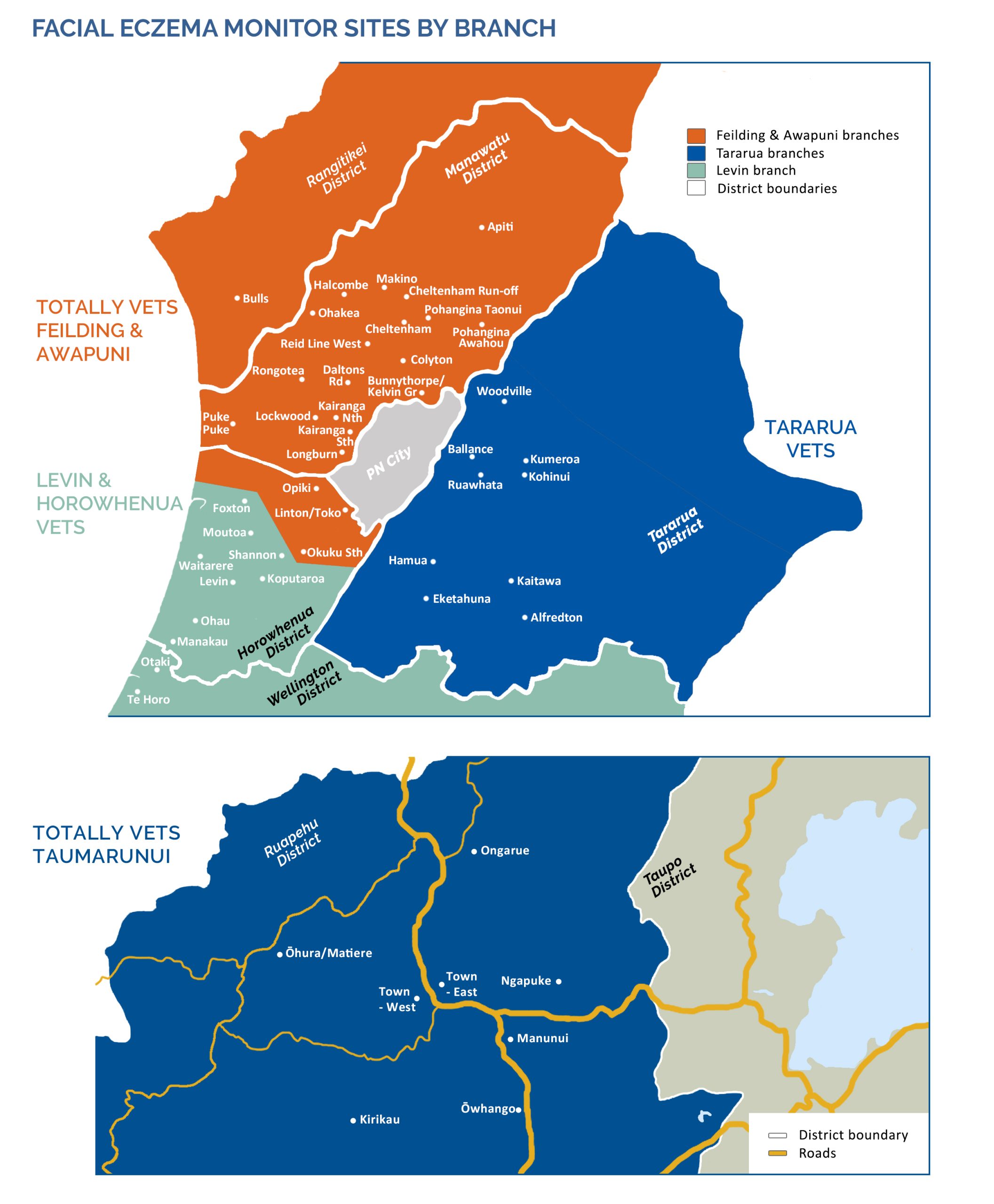
 FeildingAwapuniTararuaTaumarunuiLevin
No. of sites monitored:1214410
Average Spore Count50,000205,00045,00060,00040,000
Highest Spore Count:215,000205,00095,000150,000100,000
Lowest Spore Count:005,0000
Facial Eczema Risk Rating (Based on average spore count)HIGHHIGHHIGHHIGHHIGH

Please Note: a ‘0’ count indicates that there were no spores found in the sample. If a sample isn’t taken that week, this is indicated by a dash or ‘no sample’. 

What is a toxic spore level? It is best not to use absolute levels, as stock grazing pasture with spore counts as low as 20,000-40,000 can sustain liver damage. More important considerations are rate of spore count rise, prevailing weather conditions, and grazing intensity at the time. Toxin effects on the liver are cumulative. Play it safe – start prevention as soon as spores are detected.

The average spore count across the region has continued to trend further down from last week, however, many of the northern sites remain above the danger thresholds and sites like Waitarere have doubled since last week.

 
Soil temperatures at the northern sites were 16.2°C on average, and the southern sites were 17.2°C on average; these temperatures combined with the rainfall experienced across the region in the last week may provide appropriate conditions for continued spore production.
 
Multiple clinical cases have been seen in both cattle and sheep recently, so animals with inadequate zinc levels are at risk of developing clinical signs and may have already been experiencing subclinical production losses.
 
If you started dosing with zinc early in the season, we can process blood samples for zinc testing to identify risk of zinc toxicity.
 
Talk to us if you want to know more.
 
 Recommendations:  
 
  • Alpacas – All areas should be feeding zinc pellets. Alpacas are affected by facial eczema at low counts of 10,000, so starting zinc pellets at counts as low as 5,000 will help ensure ideal prevention before spore counts rise to dangerous levels.  
 
  • Bolusing or oral drenching – All areas should have bolused or be doing zinc oral drenching. Most have just administered their second bolus. Call us if you need help with this.
 
  • Water dosing (cattle) – All areas should be at their appropriate zinc dosing levels. Consider full dosing if not doing so already.  As you approach 90 days of zinc in the water, we recommend taking some blood samples to look at zinc levels in the blood and GGT (monitor liver damage).  
 
  • Pasture spraying – At this point in the season, for most areas, it is too late for pasture spraying as a prevention strategy now.
 
  • Feeding a crop – Crops are generally lower in spore counts. If you have a crop, these should be utilised (if you have them) over the next month. Smaller blocks can feed hay too.
 
  • Breeding – Facial eczema tolerance can be selected for using rams or bulls. These tolerant animals can then leave progeny with some tolerance to facial eczema. This is a long-term plan.  

Spore counting is $37 (incl GST) per sample, dropping to $30 for multiple samples. For instructions on how to cut grass see HERE 

Click here for further advice on facial eczema prevention.

If you have any questions pop into the clinic or give us a call on 06 368 2891 (Extension 1 for the farm team)

Signup for our facial eczema bulletin email here